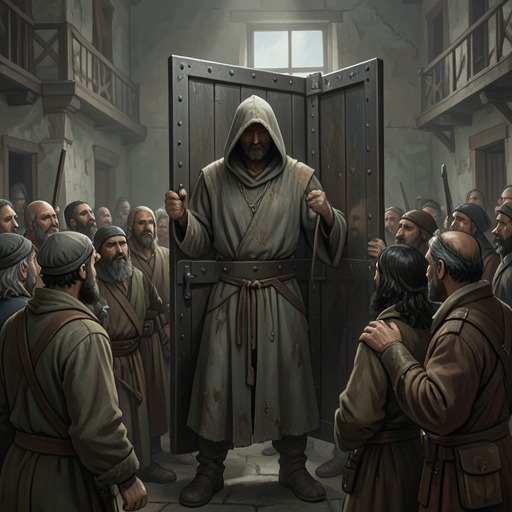
Pablo's seizure of the village and assault on the Guardia Civil barracks
For Whom the Bell TollsPablo's seizure of the village and assault on the Guardia Civil barracks is a remembered episode in which military coordination gives way to execution and then to collective violence. Pilar recounts how Pablo arranged the attack, secured the village, and directed the fate of the captured guards; her testimony also traces the killing of other local fascists in the plaza, where an organized spectacle deteriorates into a mob. The episode matters not only for what Pablo’s operation accomplished, but for the moral and political consequences Pilar and Robert Jordan draw from its changing forms of violence.
The Assault and Surrender
Pilar begins her account with the early-morning surrender at the barracks. Pablo had surrounded the building under cover of darkness, cut its telephone wires, placed dynamite beneath one wall, and called on the Guardia Civil to surrender. They refused. At daylight, he blew open the wall, and fighting followed: two guards were killed, four wounded, and four surrendered.
The assault was conducted from outside the damaged building. Pablo’s people fired into the breach while smoke and dust still hung over it; the guards inside continued firing until a shout called for the attackers to stop. The four surviving guards then came out with their hands raised. The collapsed section of roof and the opened wall made the defeat of the barracks visible, but surrender did not end the violence.
Pablo ordered four of his men to guard the captives against the wall while he and the others went inside to deal with the wounded. When they came back out, the firing and other sounds from within had ceased. Pablo carried a shotgun on his back and a Mauser pistol in his hand, which he said had belonged to the officer who killed himself. He had never fired a pistol and asked one of the guards to explain how it worked, then stopped him before he could demonstrate. The exchange places Pablo’s unfamiliarity with the weapon beside his control over the prisoners’ fate.
The Executions and Their Immediate Aftermath
The four captured guards remained against the wall while the violence inside the barracks continued. Once Pablo and his companions returned, the captives were made to kneel. Pablo went behind them and shot each in turn. Pilar’s recollection distinguishes the men’s different responses: one held his head still, another pressed his forehead against the stone, one trembled, and the last put his hands over his eyes. The killing was carried out individually, but the prisoners had no choice in what happened to them.
Afterward, Pablo handed Pilar the pistol because he did not know how to lower its hammer. The gathered group stood in silence. The guards and their captors were alike covered with dust from the explosion, but blood from the dead men darkened the ground beside the wall. The episode’s contrast between victory and its human cost is present in the ordinary details of the morning: no one had yet eaten or drunk coffee, and the sun was only then rising over the hills.
Pilar and the others went up into the town and toward the plaza. She says the four guards were the last people shot in the village, distinguishing their deaths from the further killings that followed. Her account does not treat the assault as an isolated battle: taking the town opened onto a separate campaign against its fascist residents, with different participants and a different, increasingly uncontrolled form of violence.
The Plaza and the Planned Procession
Pilar’s account then shifts from the barracks to the town plaza, a space whose layout made it possible to turn political control into a public proceeding. The square stood on the high bank above the river, with a fountain, benches, shade trees, and balconies overlooking it. Six streets entered the plaza; arcades covered three sides, while a tree-shaded walk ran along the fourth, beside a cliff that dropped three hundred feet to the river. Pablo had already seized the fascists in their homes at the same hour the attack on the barracks began, preventing them from striking the attackers from behind or on their flanks. He organized the plaza as he had organized the assault: street entrances were blocked with carts, and the prisoners were held in the Ayuntamiento, the largest building on one side of the square. The arrangement was deliberate, not improvised; the space was made to contain both the captives and the villagers who would witness what followed.
Pilar recalls initially understanding the procession as a collective act in which the people would share responsibility for the executions. She had wanted to share the guilt as well as the anticipated benefits of taking the town, and she saw the plan as organized, if troublingly theatrical. A man objected when she wore a three-cornered Guardia Civil hat as a joke, telling her that the group had finished with such things. Pilar removed it, and he threw it over the cliff. The small gesture marked an attempted break with the old authority, but it could not determine what the new gathering would become.
The Procession Breaks Down
The first prisoner to come out was Don Benito Garcia, the mayor. He walked between two lines of men carrying flails, while the crowd watched from the balconies and from the windows of the Ayuntamiento. For a time, nothing happened. Then a man who had a longstanding land dispute with the mayor struck him, and other men joined in. They beat Don Benito, dragged him to the cliff, and threw him into the river. The attack was not a judicial procedure or a controlled execution: a personal grievance broke through the organized line and helped turn the gathering toward violence. Others followed, but the public sequence did not make each victim’s fate predictable or give the crowd a uniform purpose.
Pilar’s account also preserves moments of hesitation and protest amid the mounting violence. When Don Guillermo entered the lines, his wife called to him from a balcony. A drunk man mocked her voice; Don Guillermo rushed toward him, and the drunkard struck him. Other drunk men joined in, and men who had been jeering from the Ayuntamiento replaced some of those leaving the lines. Pilar says she had understood the killing of the guards as ugly but, in wartime, possibly necessary to preserve the Republic. The assault on Don Guillermo changed her judgment of the plaza: she felt shame and distaste as the crowd’s conduct became cruel and those unwilling to participate withdrew. She left the line and sat on a bench under one of the trees.
A later killing made the collapse unmistakable. Don Anastasio Rivas, a local fascist and wealthy grain buyer who also lent money at high interest, was pushed toward the lines by Pablo and Cuatro Dedos. Before he could enter, the crowd surged at him, and he died beneath the assault. Pilar says that afterward there were no longer lines, only a mob. The shift in her description records a change in the event itself: Pablo’s arrangement had placed the violence within an ordered public form, but the crowd’s collective attack dissolved that form and its limits.
The End of the Killings and the Story’s Afterlife
The collapse into mob violence did not end with Don Anastasio Rivas. Pilar says she was glad not to see more of what happened inside the Ayuntamiento; a drunkard’s interruption kept her from witnessing the rest. She later saw another drunkard pouring something over Don Anastasio’s body and trying to light it, but her account marks the Ayuntamiento killings as something she was sorry to have seen and did not want to continue watching. The event thus closes not with restored order or a collective reckoning, but with Pilar’s withdrawal from the scene and her recognition that the violence had become unbearable.
Pilar’s judgment changes across the episode. At first, she accepts the execution of the captured guards as an ugly wartime necessity and understands the plaza procession as a way for the townspeople to share responsibility. The personal assault on Don Benito, the mockery and attack on Don Guillermo, and the crowd’s transformation into a mob destroy that framework. Her account distinguishes the deliberate operation against the barracks from the later killings: organization can coordinate an attack, but it cannot make the violence that follows just or controlled.
The episode also reaches beyond the plaza through the act of telling. Robert Jordan listens to Pilar and realizes that her story makes him see violence he had previously known only by report. Guerrilla fighters often left after an operation, while the peasants who had sheltered them stayed behind and suffered the reprisals; mobility meant the fighters did not learn how events truly ended. He wishes he could write Pilar’s account as she tells it, valuing the detail with which she restores the people and the village to the history of violence. Her testimony therefore becomes part of his education: it forces him to confront not only what the opposing side did, but what his own side had done and what those left behind endured.
The End of the Killings and the Story’s Afterlife
The breakdown into mob violence did not end with Don Anastasio Rivas. Pilar says she was glad not to see more of what happened inside the Ayuntamiento; after the chair she stood on broke, the crowd’s rush into the building left her outside the worst of what followed. She later saw a drunkard pouring something over Don Anastasio and trying to light it. Her account closes the episode not with restored order or a reckoning, but with her withdrawal and her recognition that the violence had become unbearable.
Pilar’s judgment shifts over the course of the story. At first, she regards the killing of the captured guards as ugly but potentially necessary in wartime, and sees the plaza procession as a way for the townspeople to share responsibility. The attacks on Don Benito and Don Guillermo, the crowd’s drunkenness, and the transformation of the lines into a mob break that framework. Her distinction between the organized assault on the barracks and the plaza killings matters: planning can coordinate violence, but it cannot ensure that violence remains controlled or just.
The event also reaches beyond the village through Pilar’s telling. Robert Jordan recognizes that her story makes him see violence he had known only by report. Guerrillas often left after an operation, while the peasants who had sheltered them remained and faced reprisals; their mobility meant the fighters might not learn how events truly ended. He wishes he could write the account as Pilar tells it, because its details restore the people and place to a history of violence that otherwise could be reduced to distant reports. Her testimony becomes part of his education, forcing him to confront not only what the opposing side did, but also what his own side had done and what those left behind endured.